
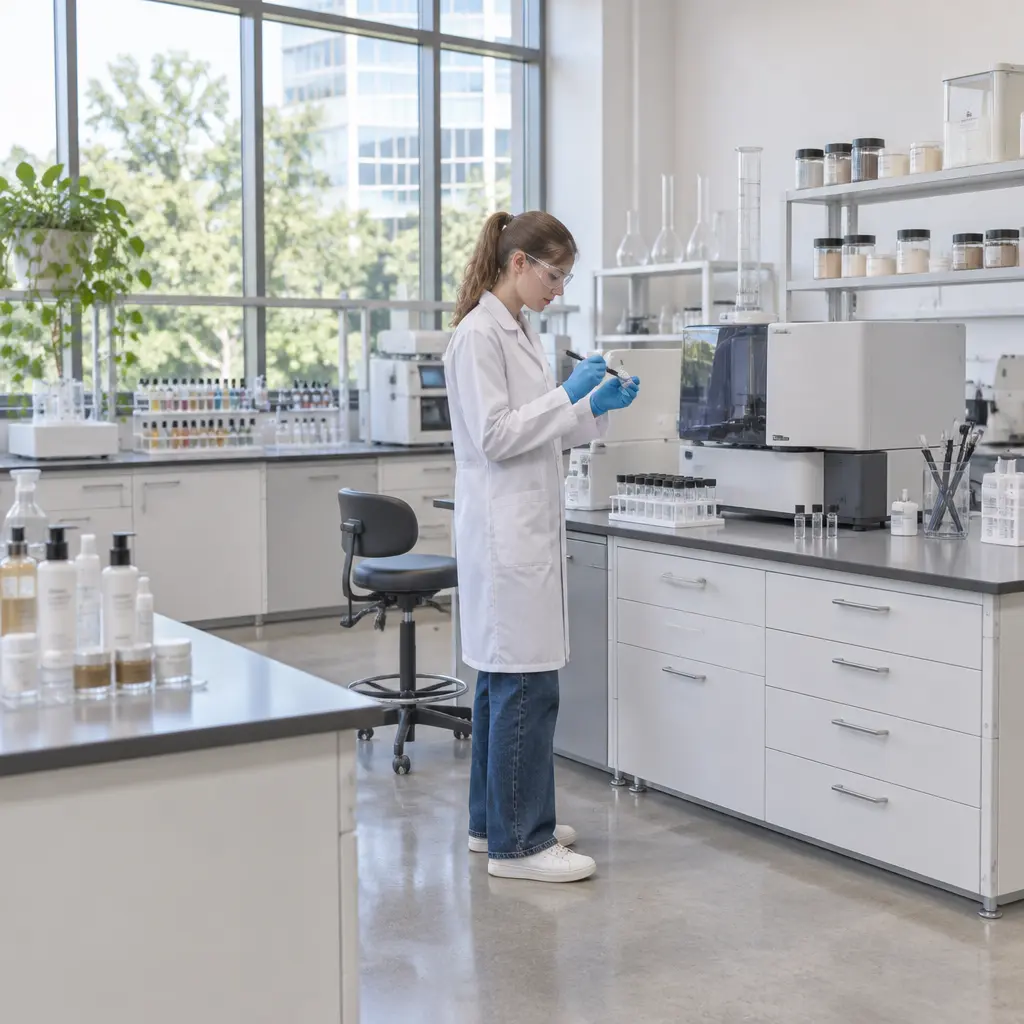
Natural beauty brands test for purity and potency by checking what a product contains, whether it is contaminated, and whether its ingredients remain effective and safe through its shelf life. These checks can include supplier documentation, laboratory identity and contamination tests, measurements of active compounds, and stability studies. The terms “natural” and “clean” do not, by themselves, guarantee a particular testing standard: in the United States, the Food and Drug Administration (FDA) does not approve cosmetics before they are marketed, while companies remain responsible for product safety and proper labeling. Understanding the testing process helps consumers assess product claims and helps brands manage risks ranging from microbial growth to mislabeled ingredients.
Cosmetic testing defines purity and potency for natural beauty products
Purity testing assesses whether a raw material or finished cosmetic meets specifications for identity, quality, and unwanted contaminants. Potency testing measures the amount or activity of a constituent associated with a product’s intended cosmetic function—for example, the concentration of a botanical marker compound or the level of an antioxidant in a formula. These meanings are practical quality-control definitions, not a single FDA-mandated certification for products labeled “natural.”
The distinction matters because a botanical ingredient can be authentic yet contaminated, or pure yet contain too little of a desired constituent to match a brand’s specification. Testing therefore combines several approaches: ingredient verification, contaminant screening, formula-level microbiological checks, and stability assessment. The FDA’s cosmetics guidance places responsibility for substantiating product safety on the manufacturer or distributor; it does not require FDA premarket approval for most cosmetics, with color additives an important exception.
The scale of the issue is reflected in FDA import alerts and regulatory actions, which identify products or ingredients that may be subject to detention or other scrutiny. Such alerts are not a measure of how often natural cosmetics fail, but they illustrate why brands need documented controls rather than relying on marketing terms or visual inspection alone.
Brands verify botanical identity and ingredient purity
Botanical identity testing confirms that a supplied plant material is the species and plant part named in purchasing specifications. Purity testing then looks for adulterants, substitution, residual processing chemicals, or contaminants. The American Herbal Products Association and the U.S. Pharmacopeia publish methods and quality references for botanical materials, while individual brands and laboratories set acceptance criteria appropriate to each ingredient and use.
Supplier qualification and traceability
Supplier qualification is the documentary and practical review a brand conducts before accepting an ingredient source. It can include a supplier questionnaire, audit, specification sheet, certificate of analysis, manufacturing information, and traceability records linking a lot to its origin and processing history. A certificate of analysis is useful evidence, but a brand may independently test incoming lots because results depend on the method, sampling plan, and laboratory that produced them.
For plant ingredients, records should identify the botanical name, plant part, country or region of origin when available, extraction solvent, and relevant processing details. These data help investigators trace a problem to a farm, harvest, extraction batch, or finished-product lot. FDA’s cosmetic good manufacturing practice guidance emphasizes documented procedures and records as part of controlling product quality.
Identity and adulteration testing
Identity tests distinguish the intended ingredient from a substitute or a material that has been diluted or blended. Depending on the material, laboratories may use microscopy, thin-layer chromatography, high-performance liquid chromatography (HPLC), gas chromatography, or DNA-based methods. No single method suits every extract: DNA testing can be limited for highly processed extracts, while chemical fingerprints may be more informative for concentrated oils or extracts.
A real-world example is essential-oil authentication. A laboratory can compare a sample’s chromatographic profile with a reference profile to look for unexpected compounds or proportions that may indicate substitution or dilution. The result is interpreted against a defined specification and method; a chromatogram alone does not prove that an oil is safe, sustainably sourced, or effective on skin.
Contaminant screening
Contaminant screening checks for unwanted substances that may enter through cultivation, water, equipment, packaging, or processing. Depending on ingredient risk, a program may include heavy metals, pesticide residues, residual solvents, microbial contamination, and mycotoxins. The FDA notes that cosmetics must not contain harmful contaminants and that product safety depends on the specific ingredients, exposure, and intended use.
Testing is risk-based rather than identical for every raw material. A mineral pigment, for instance, may warrant a different contaminant profile from a water-based botanical extract. Brands should specify methods, sampling frequency, limits, and actions for out-of-specification results; a “tested” claim without those details communicates little about the scope of the testing.
Brands measure potency and verify product performance
Potency testing checks whether a cosmetic contains a defined amount of a selected constituent or delivers a measurable activity under specified conditions. For natural products, the target may be a marker compound, a nutrient-like constituent, or a functional measure such as antioxidant capacity. Because plant composition varies with species, growing conditions, harvest, and extraction, the brand needs a clear specification and a method suitable for the finished formula.
Marker compounds and active-content assays
A marker compound is a measurable chemical used to identify or standardize an ingredient; it is not necessarily the only substance responsible for a cosmetic effect. HPLC and gas chromatography can quantify selected constituents, while spectroscopic methods may support broader composition checks. A brand may test both an incoming extract and the finished product because formulation, heat, light, and interactions with other ingredients can change measurable content.
The FDA distinguishes cosmetics from drugs partly by intended use and claims. A product claiming to treat disease or affect the structure or function of the body may fall under drug requirements, regardless of whether its ingredients are natural. Consequently, potency testing should be tied to the product’s lawful intended purpose and should not be presented as proof of a medical benefit unless the applicable evidence and regulatory requirements support that claim.
Finished-product and microbiological testing
Finished-product testing evaluates the actual formula that consumers use, rather than assuming that safe raw materials automatically produce a safe product. Microbiological testing can measure total microbial counts and check for specified objectionable organisms. The International Organization for Standardization’s ISO 17516 provides microbiological limits and methods for cosmetics, while ISO 11930 describes evaluation of antimicrobial protection, including preservative efficacy testing.
Preservative efficacy testing, often called a challenge test, exposes a product to selected microorganisms and measures whether the preservation system controls them over time. It is especially relevant to water-containing formulas, which can support microbial growth if inadequately protected. “Preservative-free” is not automatically safer: packaging, formulation, manufacturing hygiene, and intended use all affect contamination risk.
Stability and shelf-life studies
Stability testing assesses whether a product continues to meet its specifications during storage and use. Brands may monitor appearance, odor, color, pH, viscosity, packaging compatibility, microbial quality, and selected active or marker compounds under different temperature and light conditions. Accelerated studies can help identify likely failure modes sooner, but they do not perfectly reproduce every real-world storage condition.
A stability program supports decisions about shelf life and storage instructions, such as “store away from direct sunlight.” If a botanical formula changes color or loses a marker compound, the change may signal degradation, but appearance alone cannot establish potency or safety. The Cosmetic, Toiletry and Perfumery Association and cosmetic-science references describe stability as an important part of product development and quality assurance.
Testing standards, claims, and consumer interpretation
Testing results are meaningful only when connected to a defined method, a representative sample, an acceptance limit, and a record of corrective action. International standards can provide shared methods, but certification to a standard is not the same as FDA approval, and a laboratory result does not validate every claim on a package. Brands should explain what was tested and avoid implying that “natural,” “organic,” or “clean” automatically means contaminant-free.
Good manufacturing practices and documentation
Good manufacturing practices (GMP) are procedures intended to control production and prevent mix-ups, contamination, and inconsistent batches. In cosmetics, GMP programs commonly cover facility hygiene, equipment cleaning, ingredient weighing, batch records, quality checks, complaint handling, and product release. FDA has published cosmetic GMP guidance, and ISO 22716 provides an internationally recognized framework for cosmetic GMP.
Documentation connects laboratory data to the product a customer buys. Batch records and retain samples allow a company to investigate complaints, compare production lots, and conduct recalls if necessary. Under the Modernization of Cosmetics Regulation Act of 2022 (MoCRA), the FDA gained additional authorities and requirements concerning cosmetic facility registration, product listing, safety substantiation records, and serious adverse-event reporting, subject to statutory provisions and exemptions.
Reading testing and certification claims
Consumers can look for specific, verifiable descriptions rather than broad phrases. “Tested for heavy metals” is more informative when the company identifies the tested materials, analytes, method, and frequency. Third-party certification may add independent review, but its scope varies: an organic certification, for example, addresses defined production and handling criteria and does not by itself establish that a finished cosmetic is microbiologically safe or potent.
The FTC’s Green Guides caution that environmental marketing claims should be clear and substantiated. Although the guides focus on environmental claims rather than laboratory quality standards, the principle is relevant: brands should not use vague language that leads consumers to infer a level of testing or safety that the evidence does not support.
Conclusion: Purity and potency depend on evidence across the product life cycle
Natural beauty brands test for purity and potency through supplier qualification, botanical identity checks, contaminant screening, active-content assays, finished-product microbiology, and stability studies. These practices work together: traceability helps locate a problem, laboratory methods establish whether specifications are met, and GMP documentation helps ensure results apply consistently from batch to batch.
The broader lesson is that “natural” is not a substitute for evidence. Consumers can ask brands what was tested, whether tests covered raw ingredients or finished products, and how the company supports shelf-life and safety claims. Brands should use risk-based testing, qualified laboratories, clear specifications, and transparent claims—and consult FDA guidance and applicable ISO standards when building or evaluating a quality program.
For further reading, review FDA cosmetics safety and MoCRA resources, ISO 17516 and ISO 11930 summaries, and FTC guidance on substantiating marketing claims. These sources help distinguish a meaningful quality system from a general assurance that a product is “clean” or “pure.”
Sources: U.S. Food and Drug Administration, Cosmetics Laws and Regulations, https://www.fda.gov/cosmetics/cosmetics-laws-regulations; U.S. Food and Drug Administration, Cosmetic Product Testing, https://www.fda.gov/cosmetics/cosmetics-science-research/cosmetic-product-testing; U.S. Food and Drug Administration, Modernization of Cosmetics Regulation Act of 2022 (MoCRA), https://www.fda.gov/cosmetics/cosmetics-laws-regulations/modernization-cosmetics-regulation-act-2022-mocra; International Organization for Standardization, ISO 17516:2014 Cosmetics—Microbiology—Microbiological Limits, https://www.iso.org/standard/59938.html; International Organization for Standardization, ISO 11930:2019 Cosmetics—Microbiology—Evaluation of the Antimicrobial Protection of a Cosmetic Product, https://www.iso.org/standard/75058.html; International Organization for Standardization, ISO 22716:2007 Cosmetics—Good Manufacturing Practices (GMP), https://www.iso.org/standard/36437.html; Federal Trade Commission, Guides for the Use of Environmental Marketing Claims, https://www.ftc.gov/business-guidance/resources/green-guides; U.S. Pharmacopeia, Herbal Medicines Compendium, https://www.usp.org/products/herbal-medicines-compendium; American Herbal Products Association, Botanical Identity References Compendium, https://www.ahpa.org/ahpa-botanical-identity-references-compendium.