
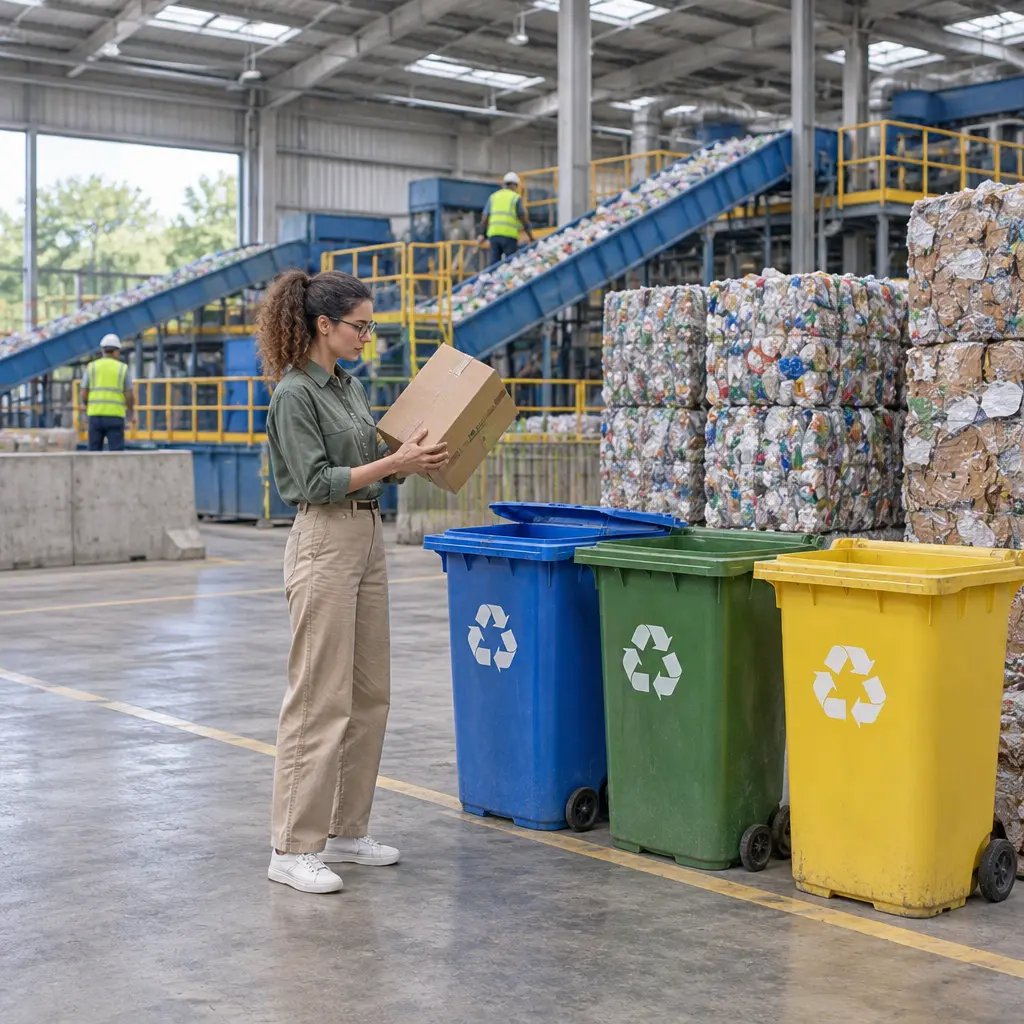
Eco-friendly packaging is not recyclable simply because its label names a recyclable material: practical recyclability depends on whether local collection, sorting, and processing systems can handle the specific package and whether the recovered material has a viable end market. The U.S. Environmental Protection Agency (EPA) reported that 32.1% of municipal solid waste was recycled or composted in 2018, while the Federal Trade Commission’s Green Guides caution that an unqualified “recyclable” claim may be misleading when appropriate facilities are not available to a substantial majority of consumers. Assessing infrastructure alongside material labels helps businesses and consumers distinguish technical potential from real-world recovery, compare packaging formats, and identify actions that can improve circularity.
Recyclability Infrastructure and Eco-Friendly Packaging Assessment
Recyclability infrastructure means the interconnected systems that collect, sort, process, and market discarded materials for use in new products. The Ellen MacArthur Foundation’s definition of a circular economy emphasizes eliminating waste and pollution, circulating products and materials, and regenerating nature; for packaging, that ambition depends on functioning local systems, not just a material’s theoretical ability to be reprocessed. An assessment should therefore examine collection access, sorting compatibility, processing capacity, recovery yield, and end-market demand.
These factors matter because packaging waste is large and material recovery is uneven. The OECD estimated that 353 million tonnes of plastic waste were generated globally in 2019, and only 9% of plastic waste was ultimately recycled. The figure underscores the gap between items described as recyclable and materials actually returned to productive use. In the sections below, the assessment moves from collection and sorting to processing and markets, then applies those criteria to packaging formats and practical decisions.
Collection Access Determines Packaging Recyclability Infrastructure
Collection access is the availability of a practical route for residents or businesses to place a package into a recovery system. The U.S. Federal Trade Commission’s Green Guides state that marketers should qualify an unqualified recyclable claim when recycling facilities are not available to at least 60% of consumers or communities where the product is sold. This threshold concerns access to appropriate facilities; it does not mean that 60% of collected packaging is successfully recycled.
Curbside and Drop-Off Collection
Curbside collection gathers accepted materials from homes and businesses, while drop-off collection requires users to bring materials to a designated site. Both count as infrastructure only when the specific package is accepted, collected regularly, and routed to a functioning processor. The U.S. EPA’s 2018 national data show that recycling and composting together accounted for 32.1% of municipal solid waste management, but national averages cannot confirm that a particular package is accepted in an individual municipality.
For an assessment, verify local acceptance lists rather than relying on a chasing-arrows symbol or a generic resin code. Ask whether the program accepts the package’s material, shape, color, size, and attached components. A container may be accepted while its cap, sleeve, pump, or flexible film is excluded.
Access, Participation, and Contamination
Access describes whether a collection service is available; participation describes whether people use it correctly; contamination refers to unwanted materials that reduce the quality or usability of collected recyclables. These are distinct measures. A package can be accepted by a collection program yet fail to reach a recycler because of contamination, incorrect sorting, or operational losses.
The OECD’s 2019 global plastics analysis found that 15% of plastic waste was collected for recycling, but 40% of that collected amount was disposed of as residues. This illustrates why collection tonnage alone is not proof of successful recycling. A robust review should request data on contamination, reject rates, and the final destination of collected material.
Sorting Compatibility Connects Collection to Material Recovery
Sorting compatibility is the ability of a package to be identified and separated by the equipment and operating practices used at a materials recovery facility (MRF). The U.S. EPA describes MRFs as facilities that receive and separate recyclable materials so they can be prepared for sale to manufacturers. A package’s recyclability therefore depends partly on whether it can be recognized and sorted into the correct commodity stream without disrupting other materials.
Material, Shape, Color, and Component Design
Sortability is influenced by more than a package’s primary material. Optical identification, magnets, eddy currents, screens, and manual quality checks may separate different items, but small pieces, dark pigments, labels, closures, and mixed-material constructions can complicate separation. Design for recycling aims to make packaging recognizable and compatible with the intended collection and sorting system.
The Association of Plastic Recyclers’ design guidance, for example, evaluates package features such as colorants, labels, closures, and adhesives for their effects on recycling streams. Businesses should assess a complete package—including its cap, label, liner, and inks—rather than making a claim based only on the main container material.
Flexible Packaging and Multilayer Materials
Flexible packaging includes films, pouches, and bags; multilayer packaging combines materials to achieve barriers or durability. These formats can be difficult for conventional MRF systems to handle because lightweight films may wrap around equipment, while bonded material layers may be hard to separate. Some store drop-off programs accept specified plastic films, but acceptance is location- and program-specific and does not establish that every flexible package is recyclable.
The OECD reported that only a small share of global plastic waste was recycled in 2019, despite collection efforts, reflecting constraints that include sorting and processing. When evaluating a pouch or film, confirm the exact program rules, check whether the package is eligible rather than merely made of a listed polymer, and seek evidence that the collected material reaches a recycling operation.
Processing Capacity and End Markets Verify Actual Recyclability
Processing capacity is the ability of a facility to convert sorted material into a usable secondary raw material. End-market demand is the presence of buyers that can use that output. Together they distinguish a package that is collected or technically recyclable from one that is recovered at scale. A credible assessment tracks material through the chain: collection, sorting, reprocessing, output quality, and sale or use.
Mechanical and Chemical Recycling Routes
Mechanical recycling physically sorts, cleans, and reprocesses material, commonly by shredding and remelting plastics or pulping paper. Chemical recycling refers to processes that convert certain materials into chemical feedstocks or other products. These routes differ in feedstock requirements, energy use, yields, outputs, and commercial maturity; a technology’s existence does not by itself prove that a particular package is routinely recycled.
The OECD’s assessment of global plastics found that 9% of plastic waste was ultimately recycled in 2019, with most recycled plastic processed mechanically. When a company cites an emerging process, it should disclose whether the facility is operating commercially, what material it accepts, the amount processed, the recovery yield, and the destination of the output.
Fiber Packaging, Glass, and Metals
Paper and cardboard, glass, and metal packaging each rely on distinct collection and reprocessing pathways. Fiber recovery can be affected by food contamination, coatings, and composite layers; glass recovery depends on suitable collection and sorting; and metal recovery depends on separation and access to smelters or other processors. No material category is automatically recyclable in every place or package configuration.
For a real-world comparison, the EPA’s 2018 U.S. municipal waste figures show that recycling performance varies substantially by material category. Such national data can identify broad patterns, but local facility specifications and verified destination records are needed to determine whether a specific package is recovered. A useful chart for a packaging assessment would compare, by format and region, collection access, MRF acceptance, processing capacity, reject rate, and verified end-market destination.
Eco-Friendly Packaging Claims Need Evidence Beyond Labels
An environmental claim is credible when its wording matches the evidence and the relevant disposal conditions. A recyclable label, resin identification code, or compostable statement should not be treated as proof that local infrastructure exists. The FTC Green Guides advise marketers to substantiate environmental marketing claims and to qualify recyclable claims when access to appropriate facilities is limited. The practical question is not merely “What is this made of?” but “Can this exact package be collected, sorted, processed, and sold where it is used?”
A Practical Verification Checklist
A packaging assessment can use the following checks to document the difference between material potential and operational recovery:
- Identify every package component, including closures, labels, liners, coatings, and adhesives.
- Check municipal or commercial collection guidance for the locations where the package is sold or discarded.
- Confirm acceptance with the relevant MRF or program operator, including size, color, and preparation requirements.
- Identify the downstream processor and verify that it handles the material and package format in question.
- Request evidence on annual throughput, contamination, reject rates, recovery yield, and output destinations.
- Review whether a stable end market exists and whether recovered material is used in a new product.
- Qualify consumer-facing claims to reflect geographic limits, required preparation, and any component that must be discarded separately.
This checklist also supports procurement decisions. Brands can compare packaging alternatives using local recovery performance, recycled content, reuse potential, protection of the product, and life-cycle impacts rather than assuming that a single “recyclable” attribute makes one option environmentally preferable in every context.
Conclusion: Measure the System, Not Just the Material
Recyclability infrastructure assessment connects collection access, sorting compatibility, processing capacity, and end-market demand. The evidence from the EPA, FTC, and OECD shows why labels alone are insufficient: collection does not guarantee recovery, and technical recyclability does not establish that a package is accepted or processed locally. Businesses should verify the complete recovery pathway and communicate limitations clearly; consumers can consult local program guidance and separate components as instructed. Better packaging decisions begin with transparent, location-specific evidence—and with reducing unnecessary packaging and supporting systems that can demonstrably recover what remains.
Sources: U.S. Environmental Protection Agency, National Overview: Facts and Figures on Materials, Wastes and Recycling, https://www.epa.gov/facts-and-figures-about-materials-waste-and-recycling/national-overview-facts-and-figures-materials; Federal Trade Commission, Guides for the Use of Environmental Marketing Claims (Green Guides), https://www.ftc.gov/legal-library/browse/rules/green-guides; OECD, Global Plastics Outlook: Economic Drivers, Environmental Impacts and Policy Options, https://www.oecd.org/environment/plastics/plastics-outlook/; Ellen MacArthur Foundation, What Is a Circular Economy?, https://www.ellenmacarthurfoundation.org/topics/circular-economy-introduction/overview; Association of Plastic Recyclers, APR Design Guide, https://plasticsrecycling.org/apr-design-guide/.